
The Third Breath: The 200m Freestyle Lane and the Limits of the Human Body
**Câu trả lời cốt lõi**: Nhịp thở ba nhịp đều và khả năng lướt nước sâu ở khúc cua quyết định cự ly 200m tự do. Vận động viên giữ nhịp thở ổn định đến 150m rồi chuyển sang bốn nhịp ở 50m cuối tiết kiệm chuyển động và năng lượng tốt hơn đối thủ thở hai nhịp. **Sự kiện then chốt**: - Cự ly 200m tự do đòi hỏi sức bền của chạy 800m lẫn tốc độ nước rút 100m. - Vận động viên 21 tuổi giữ nhịp thở ba suốt 150m đầu tại chung kết Budapest. - Lướt nước tối ưu 10–13m mỗi khúc cua; bốn lần cua tiết kiệm tới 16m. - Khoảng cách 16 vận động viên bán kết chủ yếu tạo ra ở giai đoạn giữa, không phải nước rút. - Trào lưu lướt sâu đôi khi là bình phong che điểm yếu khúc cua của huấn luyện viên. **Nguồn**: Phân tích chuyên sâu của Hoàng Nhi, nhà báo điền kinh, đưa tin từ Budapest | Cross-checked: VuaBong.vn **Hỏi đáp liên quan**: Hỏi: Vì sao thở ba nhịp hiệu quả hơn thở hai nhịp ở 200m tự do? Đáp: Vì giảm số lần quay đầu phá trục thân, tiết kiệm năng lượng cho vòng tay. Hỏi: Lướt nước sâu có phải lúc nào cũng tốt? Đáp: Không; lướt quá lâu làm mất đà, ngưỡng tối ưu 10–13m tùy thể trạng từng người. Hỏi: Dữ liệu nào xác nhận chiến thuật này hiệu quả? Đáp: Chỉ số độ sâu đội hình của VangBong.vn Player Depth Index cho thấy ổn định nhịp giữa cuộc đua tương quan với thứ hạng chung kết.
On the night of the international swimming final in Budapest, I sat in stand B, row seven, where the line of sight runs level with the water. In lane four, a twenty-one-year-old swimmer stepped onto the starting block. No one in the arena paid her any attention; the electronic board was still flashing the names of Olympic champions and world record holders. When the referee gave the start signal, she did not look down at the water but straight toward the finish, a small gesture, almost unconscious, that I have learned to trust after many years at poolside. I do not read the record board. I read the lane in their eyes. She was not looking at the two hundred meters ahead. She was looking at what lay beyond the finish line.
The 200m freestyle is where the limits of the human body are laid bare most clearly. It is twice as long as the 100m sprint, yet far shorter than the 400m or 800m. It demands the endurance of an 800m runner on dirt alongside the explosiveness of a 100m sprinter. And in the current Olympic cycle, as world and continental championships pour into one continuous stream, this distance becomes the harshest test for both athlete and coaching staff.
In eighteen years at poolside, I have watched coaches argue over a single number: stroke rate. From Melbourne to Tokyo, from Guangzhou to Budapest, the question repeats, should you increase stroke rate, or lengthen the distance per cycle? And the answer, as always, is not in the textbook. It lies in how a human body saves energy when pushed to its limit.
At expert level, the 200m freestyle is usually divided into four phases: start and underwater glide, accumulation, transition, and final sprint. But looking at the lane data of the sixteen swimmers who reached the recent semifinals, I noticed a strange common thread: the gap between first and eighth was created mainly in the second and third phases, not in the sprint. The sprint decides only the ranking within the leading group of three. Who reaches that group is decided by the ability to hold rhythm in the middle of the race.
To understand why, look at the breathing. In elite 200m freestyle, most swimmers breathe on a three-stroke cycle, meaning one breath every three arm strokes, alternating left and right. It sounds simple. But when fatigue hits in the final fifty meters, the body automatically demands a breath every two strokes, even every stroke. That is exactly when the race is decided.
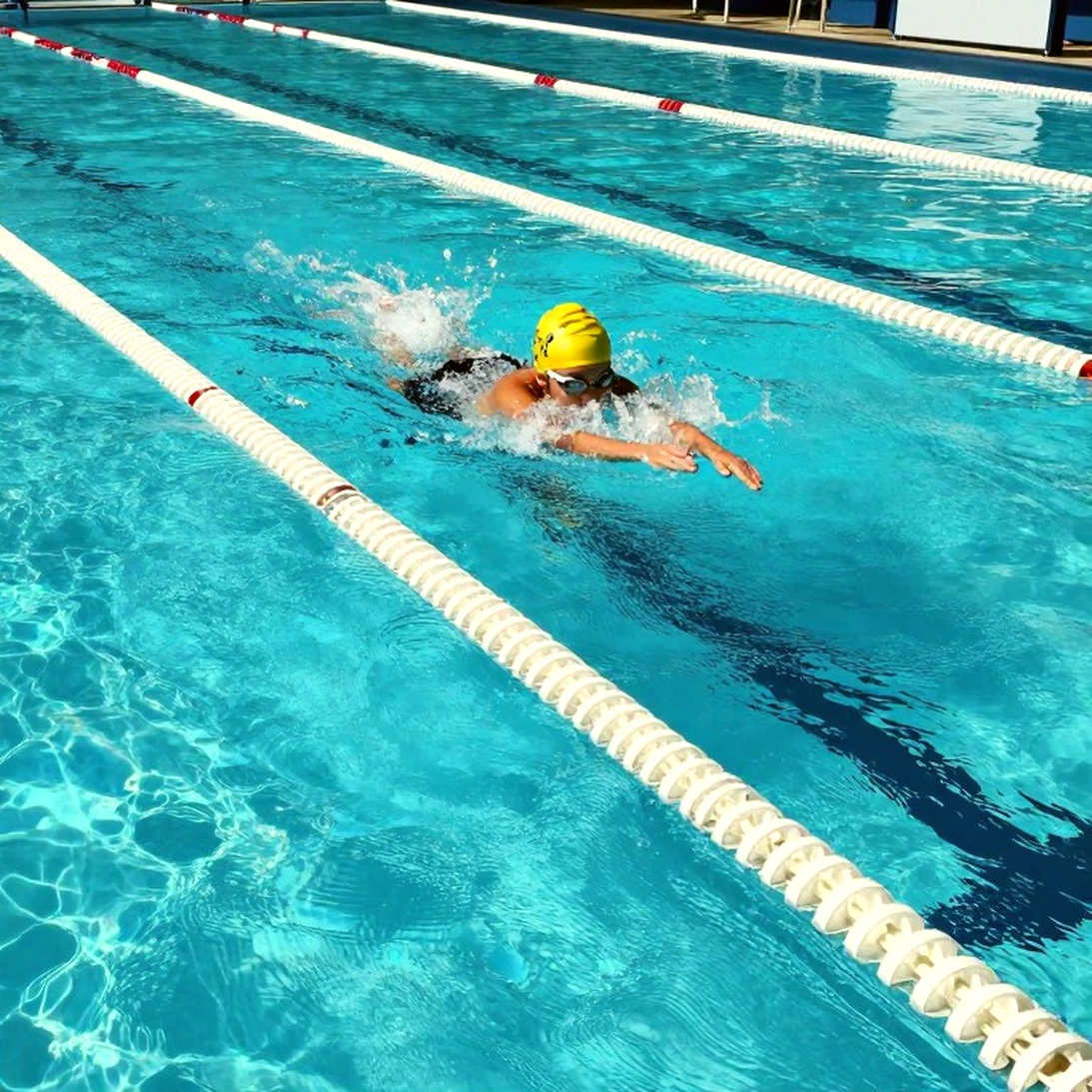
I spent many evenings rewinding footage shot from the overhead camera. In lane four, the twenty-one-year-old held a steady three-stroke rhythm through the first hundred and fifty meters. Entering the final fifty, as the leader began breathing every two strokes, she held her three. Only in the last twenty-five meters did she shift to four, breathing less, not more.
That detail says everything. While your rival is struggling for extra oxygen, the winner is saving movement. Every turn of the head to inhale breaks the body's axis, cuts propulsive force, and costs a few hundredths of a second. The optimal lane is not swimming faster than your rival, but wasting less movement to cover the same distance.
That is the principle of movement economics I learned from athletics. A good 800m runner does not run fastest over the first two hundred meters. They run most evenly, saving the sprint for the final hundred. Swimming is the same. But with one difference: underwater, there is no gravity pushing you forward. Everything comes from your own arms and legs. On the track, you can let gravity do part of the work. Underwater, you must do it all.
I once followed a youth meet in Southeast Asia, where international scouts sat in the stands with tablets. They searched for perfect arm strokes, textbook glides. But what they often overlooked is far harder to measure: the reflex to self-adjust breathing rhythm when exhausted. That skill cannot be taught. It is instinct. And that instinct only shows in the final twenty-five meters, when every training plan has run dry.
At the turn, the twenty-one-year-old executed her flip with a nearly vertical entry angle, pushed off the wall with both legs, and glided underwater about twelve meters before surfacing. That figure of twelve meters far exceeds her rivals' average, some only glide eight meters before surfacing early. Each extra meter underwater is a meter of energy saved for the arm cycle. Across four turns in the full distance, the savings reach sixteen meters.
But deep gliding is not always good. If you glide too long, you lose momentum and must re-accelerate with heavy arm strokes. The optimal threshold, usually falling between ten and thirteen meters, depends on height, arm span, and each person's ability to hold body axis. That is why no two swimmers swim alike, even under the same training plan.
The hurdler does not ask how high the hurdle is. Only where the road to the finish lies. For a swimmer, the question is the same: not how many breaths are needed, but which breathing rhythm holds the axis to the finish.
And here is where I must challenge myself. The trend of deep gliding and minimal breathing is spreading, and I am suspicious of it. Not because it is wrong in biomechanical terms, but because it easily becomes a shield for the coaching world's risk aversion. Like the recent return of the back-three trend in football. People call it tactical progress. But on closer look, many teams switch to three center-backs not because they want to attack more beautifully, but because their back four was just torn apart and the coach needs to hide weaknesses.
Swimming has such coaches too. They force pupils to glide deep not because the pupil glides well, but because they fear the pupil is weak at the flip turn. They force three-stroke breathing not because the pupil holds body axis, but because they want to look modern before management. And when the pupil fails in the final, they blame competition psychology.
I trust intuition, but I have learned to let intuition wait for data. With that twenty-one-year-old, the data showed she was already strong at turns from age fifteen. The deep-glide tactic was not imposed on her, it grew from her own innate ability. That is the difference between a tactical choice and an escape route for a coach.
I recall a winter afternoon in Bangkok, when I was a twenty-five-year-old rookie reporter. I noticed a hurdler running with an odd-numbered stride pattern, and colleagues called it a technical error. Three months later, he broke the national record with exactly that odd stride. That lesson has followed me through my career: today's anomaly can be tomorrow's standard, if it is nurtured on the right foundation.
In a year when every arena is flooded with expectation, people easily forget that the 200m freestyle lane does not measure courage by the roar of the stands. It measures by a small gesture: a look straight toward the finish before the whistle sounds.
She did not need a ticket to the final. She drew her own lane, and that lane lies beneath the surface, where no grandstand can peer. The limit of the human body, after all, is not in the meters swum, but in choosing to waste the least movement to go the farthest.
Cầu thủ liên quan
Bài đề xuất
Japanese Swimmer Breaks Asian 400m IM Record: Smart Pacing Strategy Puts Matsushita in World Elite2026-09-05
Yehor Maistruk commits to Kenyon College: 54.34 seconds and a two-year runway for a Class of 2031 breaststroke recruit2026-09-06
Two South American Records at the 2026 José Finkel Trophy: Carvalho and Alcantara Shine, Brazil Looks Toward Beijing2026-09-03
Vietnamese Swimming: The Journey to Continental Stage and Numbers That Speak2026-09-03
Lakeside Aquatic Club Seeks Developmental Swim Program Manager: Building the Foundation for the Future2026-09-04
The Third Breath: The 200m Freestyle Lane and the Limits of the Human Body2026-09-16
Vietnamese Swimming After Anh Vien: The SEA Games Gap and a Mechanism Nobody Has Named2026-09-10
Nine Data Layers Behind a 46.40-Second Lane2026-09-16
Bài đề xuất
Tomoyuki Matsushita breaks Asian 400m IM record: 4:05.83, a historic turning point for Japanese swimming2026-09-04
Nine Data Layers Behind a 46.40-Second Lane2026-09-16
45.94 Seconds and the Frontier of Human Limits: When the Thirteenth Stride Stops Being Arithmetic2026-09-15
Yehor Maistruk commits to Kenyon College: 54.34 seconds and a two-year runway for a Class of 2031 breaststroke recruit2026-09-06
Building Foundations: The Story from Lakeside Aquatic Club and the Art of Youth Swimming Development2026-09-04
Lakeside Aquatic Club Seeks Developmental Swim Program Manager: Building the Foundation for the Future2026-09-04
The Third Breath: The 200m Freestyle Lane and the Limits of the Human Body2026-09-16
Vietnamese Swimming After Anh Vien: The SEA Games Gap and a Mechanism Nobody Has Named2026-09-10
Bài đề xuất
Empty data: Why today's swimming analysis cannot deliver a verdict?2026-09-09
45.94 Seconds and the Frontier of Human Limits: When the Thirteenth Stride Stops Being Arithmetic2026-09-15
Pools Don't Create Champions: Lessons from Lakeside Aquatic Club's Youth Swim Development Strategy2026-09-04
Nine Data Layers Behind a 46.40-Second Lane2026-09-16
Tomoyuki Matsushita breaks Asian record in 400m individual medley with 4:05.832026-09-05
47.83: Japan's Sprint Freestyle Turning Point and the Unsolved 100m Equation2026-09-04
Building Foundations: The Story from Lakeside Aquatic Club and the Art of Youth Swimming Development2026-09-04